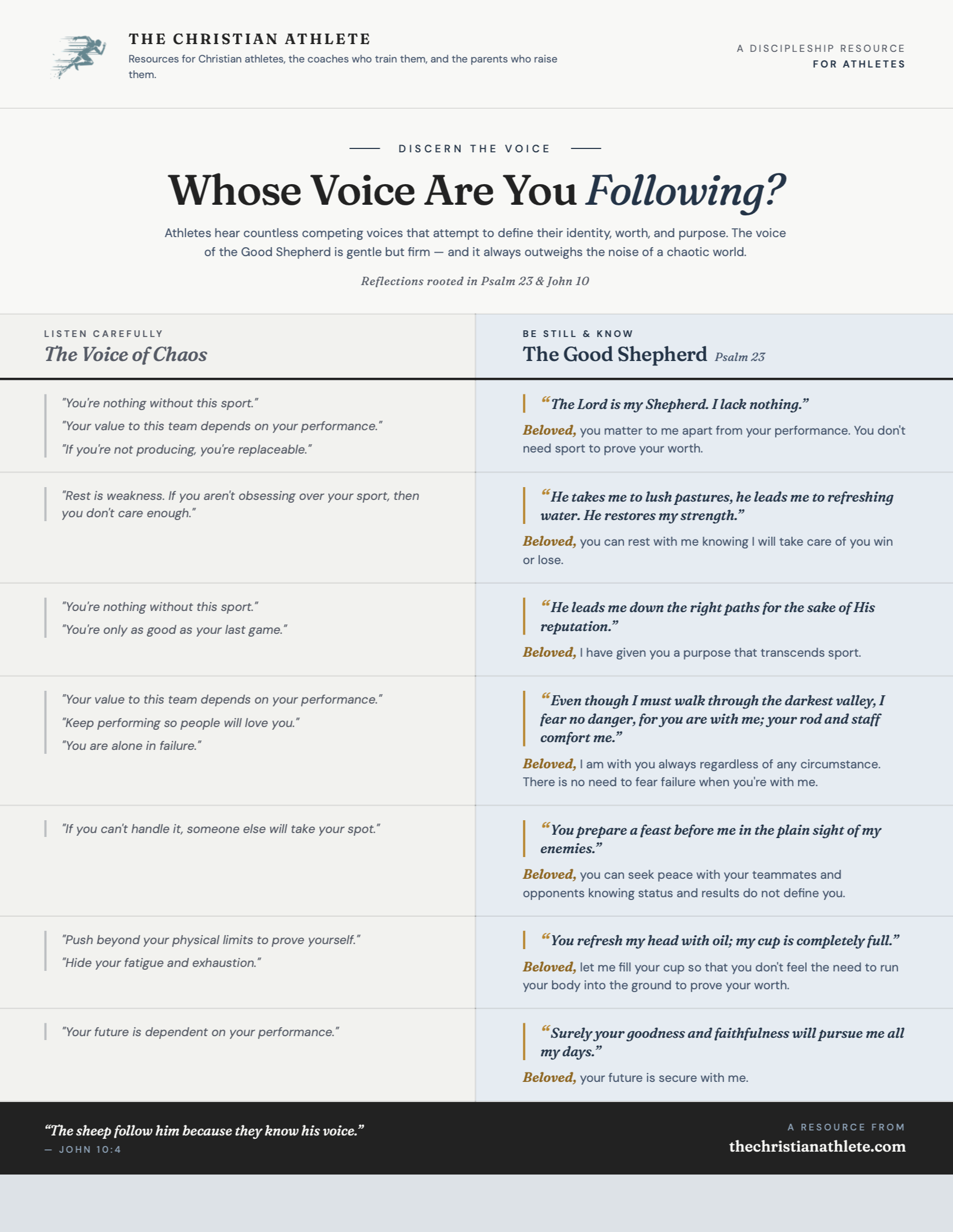
Athletes, Whose Voice Are You Following?
I often heard many voices during competition as a youth—other parents, coaches from both teams, teammates, the referee, and even my internal dialogue was often raging. My mom is not typically the loudest person in the room, yet her voice was always the clearest to my ears from the sideline. There could be chaos all around me as I played but when my mom spoke gently and firmly, something about her voice cut through all the noise. It was as if my ears were programmed to hear her voice. As a child, there was no single person who knew me so intimately and loved me so deeply as my mother did. So when I heard her voice on the sidelines, my attention rested on her words. It was the clear voice I needed to remind me who I was in the midst of competition.
We are offered many voices that attempt to define our identity, worth, and purpose in life and sport. A parent’s voice reminds us that we are loved unconditionally. A parent’s voice may reinforce that we must perform to gain their attention. A coach’s voice can powerfully recognize natural ability. A coach’s voice may also label us according to our shortcomings and failures. A teammate may call us higher with a posture of encouragement or use their words to cut down others.
With all of these competing voices, we need a clear, gentle, and firm voice to follow that outweighs messages we receive from a chaotic world. There’s no better place to look than the voice of Jesus, our Good Shepherd.
Parable of the Good Shepherd
Jesus healed a man born blind prior to teaching a parable about the voice of the Good Shepherd. Because of his blindness, this man was labeled a “sinner” and “outcast” by the community and religious leaders. These labels became the man’s lived experience and identity.
Jesus reaffirmed his dignity and place in society by restoring his sight. This angered the religious leaders and they responded by isolating the man from the community. In response, Jesus used a parable about a good shepherd to correct them. The newly healed blind man is depicted as a sheep. The thieves, strangers, and hired hand is meant to depict the Pharisees who exiled the man. Jesus is the Good Shepherd whose caring relationship and gentle voice defines identity and belonging for the sheep.
The Voice of A Thief & Hired Hand
“Truly, truly I say to you, the one who does not enter by the door into the fold of the sheep, but climbs up some other way, he is a thief and a robber… The thief comes only to steal and kill and destroy…” - John 10:1&10
“He who is a hired hand, and not a shepherd, who is not the owner of the sheep, sees the wolf coming, and leaves the sheep and flees; and the wolf snatches them and scatters the flock. He flees because he is a hired hand and does not care about the sheep.” - John 10:12-13
Jesus is comparing the religious leaders to a robber and a hired hand whose motivation is certainly not to protect the dignity of the ‘sheep’. A thief by definition is self interested and seeks to exploit the sheep for selfish purposes. Similarly, the hired hand does not own the sheep and abandons them at the first sign of danger proving that he was not interested in protecting the sheep.
Notice, the nature of these relationships are transactional. The sheep to the thieves and hired hands are not worth much to them. The sheep are only a means to an end.
Perhaps, Jesus is pushing back on transactional relationships and the voices in society that attempt to define our dignity and worth on the basis of performance and productivity. This parable reminds us there are leaders with powerful voices that intentionally or unintentionally harm our humanity and shape what we believe about ourselves.
The voice of the thief or hired hand may sound like:
“If you’re not producing, you’re replaceable.”
“Your value to this team depends on your performance.”
“You’re only as good as your last game.”
“If you can’t handle it, someone else will take your spot.”
“Rest is weakness. If you aren’t obsessing over your sport, then you don’t care enough.”
“You’re nothing without this sport.”
“Keep performing so people will love you.”
The question is not whether or not these voices exist. But rather, whose voice do we permit to define our existence, dignity, and purpose? Who truly possesses the right to do so?
The Good Shepherd
“Truly, truly I say to you, I am the door of the sheep… I am the door; if anyone enters through me, he will be saved and will go in and out and find pasture… I came so that they would have life, and have it abundantly. I am the good shepherd; the good shepherd lays down His life for the sheep… I am the good shepherd, and I know my own and my own know me, just as the Father knows me and I know the Father; and I lay down my life for the sheep.” - John 10:7, 9-11, 14-15
Jesus counters the voices and transactional nature of the thieves and hired hands. He paints a beautiful vision of a life under the care of a Good Shepherd. In this depiction, the sheep belong to the Good Shepherd because of their inherent value. He has intimate knowledge of the sheep and even knows them by name. This shepherd protects the sheep from danger because he cares deeply about them. The Good Shepherd is willing to sacrifice his own life for the life of the sheep. This proves they are worth something to him.
This is an abundant life—relational connection to Jesus who defines our worth, guides our paths, and cares for us deeply. The Good Shepherd is willing to sacrifice his life for the love of humanity, not because anyone earned it. Our Good Shepherd sees our value simply because we belong to him. His voice is the only one that matters.
Consider again the audience for this parable. As the healed man listens, he hears Jesus rebuking leaders for causing harm while also being reminded that he belongs to Jesus. That is his real identity.
Are You Listening?
“The sheep listen to his voice, and he calls his own sheep by name and leads them out… the sheep follow him because they know his voice. However, a stranger they simply will not follow, but will flee from him, because they do not know the voice of strangers… All those who came before Me are thieves and robbers, but the sheep did not listen to them.”
In the West, we rarely see the bond between sheep and shepherd. Sheep are incredibly attuned to their shepherd’s specific whistle because they experience his constant care. This familiarity allows them to easily distinguish their trusted leader from any other noise.
There is no single person who knows us so intimately and loves us so deeply as the Good Shepherd. The voice of Jesus is gentle but firm as it calls us into belonging and belovedness. It’s the clear voice we need in a world full of chaos. Are you listening?